Weeknights
Weeknight dinners: a practical system for easier cooking
Plan around the time you have, check quantities before shopping and keep a realistic fallback—with a worked planning sheet, not a rigid menu.
Editorial update, 21 September 2026: added a practical worksheet, worked calculations and relevant tool links; clarified international scope and source limitations. Original publication date and source links retained. Editorial update, 18 October 2026: added a practical decision exercise and a calculator-to-notes workflow. Original publication date and sources retained.
A useful weeknight dinner system starts with your available time, a few complete recipes you already trust and a shopping list checked against what you have. Plan the quantities and the work, not just the names of the meals. Keep one fallback that genuinely fits a difficult evening.
This is a planning guide, not a recipe, dietary plan or food-safety assessment. Our worksheet and worked numbers help organise decisions. Use the original recipe for its full method and any tested serving variations; a quantity calculation cannot establish that a changed recipe will cook successfully.

Turn one dinner into a quantity check
Choose a complete recipe before changing any quantities. Write its stated yield beside the number you want to explore, then divide the second by the first. For a recipe stated to serve four and a plan for six, the arithmetic factor is 6 ÷ 4 = 1.5. That ratio does not establish whether the recipe or its method can be scaled.
Open the ingredient scaler, try its worked example, then replace the example with your own measured quantities. Keep a separate note saying which recipe each numbered row belongs to. Copy the result into your meal-planning note; the copy includes the original amounts and units so you can check the calculation later.
Before the plan becomes a shopping list, resolve three questions: does the recipe author support the changed quantity, does the equipment suit that version, and what amount is already available? If any answer is missing, keep that dinner unresolved rather than treating a neat calculation as a finished plan.
Start with the evenings you actually have
Make a short list of the nights you expect to cook and who expects to eat. Note your realistic start time, the time available for hands-on work and any equipment constraint. A recipe with little preparation but a long cooking stage may suit one evening and be useless on another. Read the whole method before treating its headline time as your complete commitment.
Our suggested starting point is two ordinary dinners and one fallback, rather than a seven-night plan you have never tried. Shift workers, people living alone and households with changing schedules can use the same questions without following a Monday-to-Friday pattern. No particular cuisine or supermarket is required: begin with meals that fit your own habits and local ingredients.
Choose repeatable formats, then choose actual recipes
A tray bake, a pan meal or a bowl can be a useful planning label, but it is not a method. Choose a specific recipe for each slot. BBC Good Food's quick-and-easy collection remains a discovery link from the original article; check the individual recipe rather than assuming everything in a collection takes the same time or permits the same substitutions.
To compare the kind of work involved, our traybake source guide and stir-fry preparation guide point to different approaches. They are routes to published recipes, not EatMojo-tested instructions. Pick the approach you can actually carry out that evening, including preparation and clearing the work area.
Use a planning sheet with decisions, not aspirations
Copy these columns into a note. Fill in the recipe title or location yourself; there is no need to upload recipe text or personal household details to a website. Keep unresolved questions visible so a missing ingredient or unworkable serving size does not become a surprise at the point you want to start cooking.
On a narrow screen, scroll the table sideways. Keyboard users can focus it and use the arrow keys.
| Meal slot | Complete recipe chosen | Quantity decision | Work to check | Fallback trigger |
|---|---|---|---|---|
| Ordinary evening | A familiar recipe | Use its stated servings | Preparation plus cooking, not headline alone | Start time becomes too late |
| More flexible evening | A second known recipe | Use a publisher-tested variation if needed | Equipment and full method | A key ingredient is unavailable |
| Difficult evening | A genuinely familiar option | Plan for those actually eating | Check what is already available | This is the fallback, not another project |
Our suggestion is to choose a clear trigger in advance: ‘If I cannot begin by the time I have written down, I use the fallback.’ That makes the plan adaptable without requiring you to make an entirely new decision when tired. A fallback can be a simple meal you know, a suitable ready-made option or another arrangement that works for you; we are not prescribing a nutritional balance.
Check the cupboard before turning meals into purchases
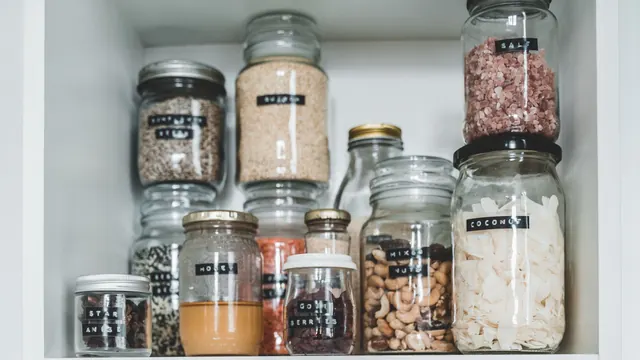
List the ingredients required by the selected recipes and check what is already available in the appropriate condition. The original Love Food Hate Waste resource remains useful background on reducing waste. Our practical worksheet is to separate ‘needed for this plan’, ‘already have’ and ‘still to buy’, rather than copying every recipe ingredient onto a shopping list.
For example, if two chosen recipes need the same dry ingredient, combine the shopping requirement only when their units and ingredient specifications match. Do not combine a dry weight with a cooked weight or assume a tin's net weight equals its drained contents. Our useful kitchen cupboard guide works through the inventory and purchase-quantity side of that decision.
Use arithmetic carefully when checking quantities
The ingredient quantity multiplier multiplies numbers you enter and keeps the selected units. It does not read recipes, recommend portions, convert cups to grams or adjust a cooking method. Use it as a calculation sheet when you already have an appropriate reason for a quantity change, such as a serving variation provided by the recipe's publisher.
A worked arithmetic example: a factor of 1.5 turns 250 g into 375 g and half a US cup into three-quarters of a US cup. A factor of 0.5 turns three items into 1.5 items; it does not decide whether that is sensible or how to handle the fraction. ‘To taste’ is not a missing number to invent: leave it unmeasured. These results do not validate a recipe, pan size, cooking time or temperature.
Keep the original unit system explicit. US, metric and Imperial cups are not interchangeable labels; weight ounces and fluid ounces describe different things. If you cannot match the publisher's measure to your equipment, use the publisher's own conversion or clarification rather than guessing. Do not use this tool for preserving, fermentation, infant feeds or other safety-critical preparation.
Keep specialist guidance separate from the meal plan
The earlier version linked Food Standards Agency chilling guidance and the NHS healthy-eating page. Those UK references remain available for their specialist context; neither is evidence that our worksheet is a complete dietary plan. Follow applicable local guidance, product instructions and the original recipe for food handling rather than treating this article as storage or reheating instructions.
Review one friction point after the week
Ask what made a planned dinner harder than expected: the start time, unfamiliar preparation, missing ingredients or an unrealistic quantity decision. Change that one part of the next plan. You need not replace the whole menu or buy new equipment because one evening changed. For more source-led options, use the weeknight archive once you know what kind of task you are trying to simplify.
Make it useful
Plan your next weeknight meal
Planning prompts only. Use the original recipe for ingredients, quantities, timings and food-safety guidance.